
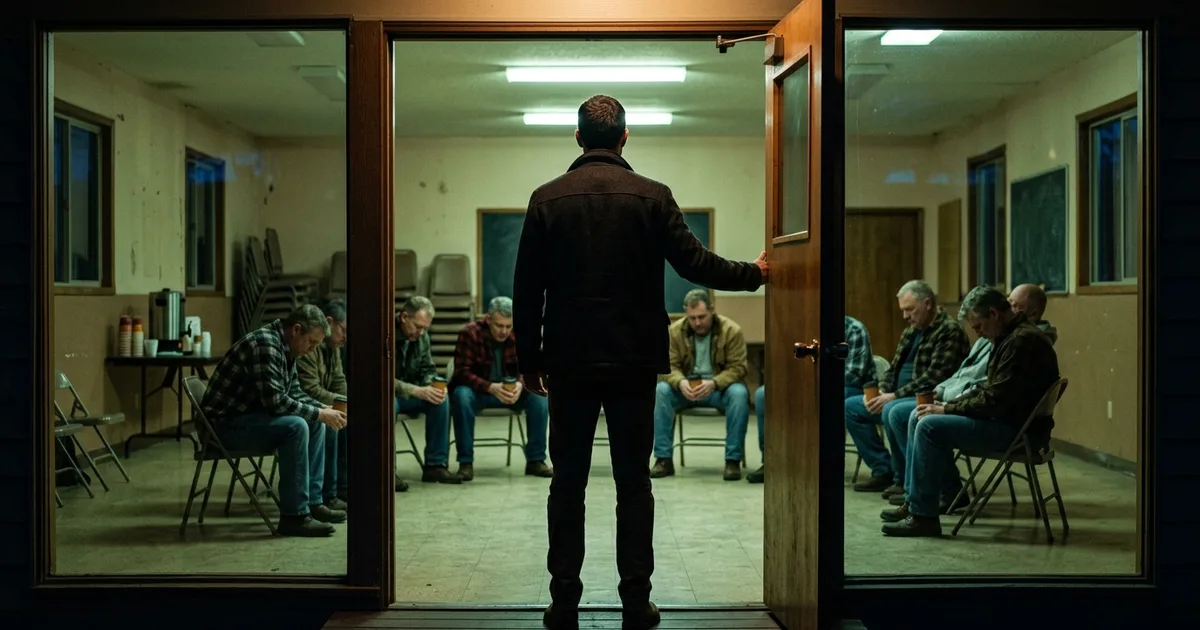
Plenty of men’s groups exist. You can find one this week. Most of them won’t have your men in them. If you’ve been typing “how to find a men’s group” into a search bar late at night, wondering why the last few rooms you tried left you flat, I spent years learning the answer the slow way.
Search “men’s group near me” and the map fills up fast. Church groups meet on Wednesday nights in the fellowship hall. Therapy circles pass a talking stick around a folding table. Bitcoin meetups, run clubs, and business mixers post their calendars every month. Supply is the easy part. Any town with a coffee shop has a room where men gather. The scarce thing is a room full of men who are aligned with you, men who build, compete, and command their own time the way you’re trying to. You can sit in five of these rooms and meet decent guys in every one. You can shake hands, trade numbers, and still drive home feeling like you spent the evening with a different species. So why do the local ones feel so wrong?
I Went Looking in the Same Places You Did
The first one was a church men’s breakfast, with folding tables in a fellowship hall that smelled like burnt coffee and powdered eggs. I sat down with a paper plate and a name tag and waited to meet my people.
The guys were decent. They showed up on time. They talked about their kids’ sports schedules, their commutes, and how many years they had left until retirement. When the conversation turned to work, their shoulders dropped. Nobody was building anything. Nobody asked what I was building either.
So I tried bitcoin meetups. Different room, same energy. It was the back corner of a brewery, with a dozen men nursing beers and checking price charts on their phones. I figured these guys would be different. They’d seen through the system, right? They understood money.
They did understand money. They just weren’t making any of their own. Most of them hated their jobs and talked about the day bitcoin would finally let them quit. Some were bitter about it. Some were angry at the Fed, at their bosses, at whoever was in the news that week. Every conversation came back to the same place: someday.
I’d drive home from those nights more tired than when I left. I had spent two hours with men who were waiting for retirement, for a price target, for someone or something to come rescue them.
I kept going back for a while, hoping the next room would be different.
It wasn’t.
The Real Problem Is Values
Most men looking for a men’s group assume the hard part is logistics. Finding a room. Picking a night. Getting there after work. I assumed that too, until I’d sat in enough rooms to see the pattern.
The problem is values.
Most men in local groups are pairbonders. I don’t mean that as an insult. It describes how their lives are arranged. They don’t lead their families. Their families lead them, and their time belongs to whoever needs something next: the kids, the wife, the in-laws, the boss. A man living like that shows up to a meetup already spent.
Money is the other half of it. Most of these men haven’t figured out how to make money online or with technology. Their income comes from one place, a job that owns their mornings and limits their options. That job becomes the crate. When one person can take away your only income, you stop taking risks. You get careful. You get stressed. You start weighing every decision by what it might cost you, and after enough years of that, the sparkle in your eye goes out.
You can see it from across the table. Guys who once had fire now talk about their limits the way they talk about the weather. They follow the rules, including the ones they complain about. They’re pleasant and they’re tired, and nothing in their lives is moving.
I’ve written more about the traits of pairbonders and how to spot them. Once you know the pattern, you’ll see it in every room you walk into.
So here’s what that means for your search. A better meeting time won’t fix a room full of men who have stopped commanding their own lives. You can change the venue as often as you like.
The men stay the same.
Waiting for Deliverance Is the Tell
After enough meetups, I stopped listening to what the men said and started listening to what they were waiting for. Almost every one of them was counting down the days until some amorphous freedom showed up. Retirement, maybe. The kids moving out. A promotion that would finally buy back his evenings. The date never gets named, because that freedom is never coming, and on some level he knows it.
Bitcoiners run the same script with a different savior. They’re waiting for bitcoin to bail out their lives. The job still owns their days and the family still owns their nights, so the plan is to hold the coin and hope the number climbs high enough to set them free. A price chart can’t command anyone’s destiny.
The same thing showed up in every room I walked into. Nobody there was commanding his destiny. They don’t believe in the power of the masculine, dominant tournament male, so they’ve never tried to become one. The result is predictable. They come off boring and rule-following, even the guys who think of themselves as rebels, and they’re scared of taking risks with anything that matters. Their wives usually mirror that. When a man hands over the wheel, the whole household settles into the passenger seat.
Now put twenty of these men in a room once a week. Each one confirms that the others’ waiting is normal, and whatever ambition you brought through the door gets quietly sanded down to fit the group’s shape. Nobody means harm. Nobody has to. A group made of waiting men trains you to wait right alongside them.
Why You Won’t Find Your Men by Accident
Start with the men you actually want. They build things. They make their own money, often online or with technology. They lead their families. Their time belongs to them. They take real risks. Be honest about how many men like that you’ve met in your life. For most of us, the count fits on one hand.
Now add geography. For a local group to work, enough of those men have to live within driving distance of you. Then they have to hear about the same meetup. Then they have to show up on the same Tuesday night, in the same room, and keep showing up month after month. Every one of those conditions shrinks the pool. Stack them together and the odds get close to zero.
So the local room fills up with whoever is available. And whoever is available is mostly pairbonders. It’s just how the math works when you’re drawing from a small circle on a map.
Facebook was supposed to fix this. The promise was that technology would help you find your people, wherever they lived. It connected everybody to everybody, and then it sorted all of us by what kept us scrolling. Outrage won. Attention won. Nobody ever built a feed that sorts men by how they live, what they build, or whether they command their own destiny.
Finding your people is harder than ever.
Community Gets Delivered Now
You don’t drive to the restaurant anymore. You open an app, tap twice, and dinner shows up at your door while you’re still working. Community is heading the same way, and most men haven’t noticed yet.
For most of history, your brotherhood was whoever lived near you. The church down the street. The guys at work. The meetup that happened to land in your city on a Tuesday night. Geography did the filtering for you, and geography is a terrible filter. It hands you men who share your zip code and almost nothing else.
Online flips the filter. When you can search a whole country, or a whole continent, you stop asking “who’s nearby?” and start asking “who actually thinks like me?” That second question matters more than any other, because men who build, lead, and take real risks are scattered thin, maybe one or two in any given room, and the only way to gather fifty of them in one place is to draw from millions of men at once.
So yes, you’ll still shake hands. In-person follows. Once the filter has done its job, you know exactly which men are worth a flight or a long drive. The meeting stops being a gamble on whoever walks through the door. You already know he’s commanding his own destiny, because that’s why he’s there.
This is how the tournament male finds his people now. The filter comes first, and the handshake comes after.
Which raises the real question: what should you look for?
What to Look for in an Online Men’s Group
Most online groups are a chat room with a logo, so here’s the checklist I use.
- A message that repels pairbonders. The best filter is a message strong enough that the wrong men don’t want in. When a group talks plainly about leading, building, and competing, the men drawn to it self-select, and pairbonders drift elsewhere on their own. A group with a soft, please-everyone message fills up with whoever wanders in.
- Standards that get measured. Every group says it has standards. Ask how they’re tracked. If nobody checks your training, your income, or the promise you made last week, then the standard is just decoration and the men will drift back to comfort.
- A daily rhythm. Men change through what they do every day. A group that meets once a month gives you one good evening and twenty-nine days back in the crate, where your job and your obligations set the pace. Look for daily check-ins, daily wins, and men who notice when you go quiet.
- Men who are building. Find men who make money beyond the job and who lead their families instead of taking orders from them. These men take risks because they’ve built enough to survive a loss. You’ll absorb the habits of whoever you spend the most time with, so pick a room that’s ahead of you.
- A path to meeting in person. Online is where the filtering happens. The handshake still matters. A good group turns screen time into real meetups with men you’ve already vetted, so every trip is worth the flight.
If a group can’t show you all five, keep looking. Tournament Male is built around every one of these five, and you can see how the system works before you decide whether it’s your territory.
”But Online Isn’t Real Brotherhood”
I hear this one all the time. A group chat can’t replace a man sitting across the table from you. Fair enough. I’d rather shake a man’s hand than read his message.
But look at what online actually does. It’s the filter. It sorts through thousands of men by what they believe and how they live, and it hands you the few who match. What you build with those men after that has no ceiling. Tournament Male members have met in person across cities, countries, and continents. They traveled to meet men they first found in a thread, because they already knew those men were worth the trip.
The local option is a real room too. You can sit in it every Tuesday night. It’s just full of the wrong men.
Pick your room.
Take the Quiz, Then Make the Call
Start with an honest look at yourself. Most men who go looking for a group are really looking for a mirror. They want proof of which side of the line they stand on. So take the 60-second quiz and find out whether you’re a tournament male or a pairbonder. Answer it the way you would if nobody were watching, because you’ll be the only one who sees it. One minute of honesty will tell you more than another year of church groups and meetups.
And if you already know the answer, skip the quiz. You’ve sat in those rooms. You’ve heard the men counting down the days to a freedom that never shows up, and you felt the sparkle drain out of the conversation. You’re done waiting for someone else to hand you a life. Join Tournament Male and meet the men who are already building their own territory.
Stop waiting.